The Boy They Laughed At
The patio fell into a silence that didn’t feel natural. Not the kind that comes from respect—but the kind that presses inward, tightening every breath.
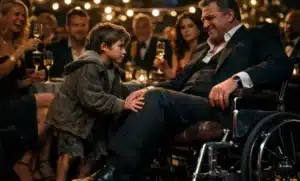
A barefoot boy stood on the cold stone floor, his fingers hovering just inches from a man’s knee. The man sat in a wheelchair, dressed in wealth and certainty, his smile edged with impatience.
“Fifteen seconds,” he said loudly. “After that, I call the police.”
Phones were already raised. Whispers circled. Someone mentioned how fast this would spread online.
The boy closed his eyes.
Then he pressed.
A scream tore through the air.
“Get your hands off me!”
And then—nothing.
The man froze. His breath stalled. His expression collapsed into something unfamiliar.
Not pain.
Something else.
Something he hadn’t felt in eleven years.
Sensation.
“That’s not possible,” he whispered.
The boy stepped back calmly.
“Try,” he said.
At first, laughter flickered through the crowd. It didn’t last. Because the man’s fingers were moving—trembling like they were remembering something long forgotten.
The Story Everyone Believed
Eleven years earlier, Marcus Hale had been told his life would never be the same.
A spinal injury. A clean, clinical verdict delivered in a quiet hospital room.
“You’ll never walk again.”
The words had settled like concrete. Absolute. Final.
But what no one explained was the truth hidden behind that certainty. His condition had been labeled unlikely to recover—not impossible.
“Unlikely” leaves room for hope.
“Never” removes it.
And “never” is far more convenient.