PART 1: The Impact
Hospitals have a rhythm of their own—measured, controlled, almost sacred. The steady beeping of monitors, the soft shuffle of nurses’ shoes, the quiet urgency that never quite becomes chaos. It’s a place where pain is expected, but never welcomed.
That’s why what happened next didn’t belong.
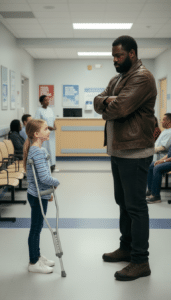
Lena moved slowly down the corridor, her crutches clicking in a careful, practiced rhythm. She was eleven, small for her age, with a determination that made her seem taller than she was. Her left leg was still healing from a fracture, the cast hidden beneath loose fabric. Each step required effort, but she carried it with quiet resilience, as if she refused to let the injury define her.
Her mother had gone to fill out paperwork. “Stay right here,” she’d said, guiding Lena to a waiting area outside radiology. “I’ll be back in a minute.”
Lena nodded. She was used to waiting.
Across the hall, a man stood near the vending machines. Mid-thirties, maybe. Disheveled in a way that wasn’t quite accidental—shirt wrinkled, eyes restless, jaw tight as if he was holding something back. He wasn’t looking at anything in particular, yet everything about him felt… off.
Lena noticed him the way children notice danger before they understand it.
She looked away.
But he didn’t.
His gaze locked onto her—on the crutches, the slow movements, the vulnerability. Something flickered across his face. Not pity. Not concern.
Something sharper.
He walked toward her.
Each step was deliberate.
Lena stiffened. Her grip tightened around the crutches. “Excuse me,” she said quietly, trying to move aside, to make space.
He didn’t stop.
“People like you,” he muttered, voice low but edged with something unstable, “always getting attention…”
Lena’s heart skipped. “I’m just waiting for my mom—”
That’s when it happened.
Fast. Violent. Unthinkable.
His foot came out of nowhere.
Thud.
The kick struck her side, just below her ribs. The force knocked her balance instantly off. The crutches slipped. Pain exploded through her body as she crashed to the sterile floor, her head striking hard against the tile with a sickening crack.
For a moment, the world went white.
Then noise rushed back all at once.
“Hey! What are you doing?!”
“Call security!”
“Get a doctor—now!”
The man didn’t run. That was the strangest part. He just stood there, breathing heavily, as if something inside him had finally snapped loose.
Within seconds, the corridor transformed.
Doctors and nurses rushed in. A nearby physician dropped to his knees beside Lena, hands already steady, controlled.
“Lena, can you hear me?” he asked, voice calm but urgent.
Her vision blurred. “I… I think so…”
“Don’t move,” he said gently. “We’ve got you.”
Another doctor stood, fury barely contained, pointing at the man. “Restrain him!”
Security arrived almost instantly, tackling the man to the ground. He struggled briefly, shouting incoherent fragments—resentment, anger, words that didn’t quite form meaning—but it didn’t matter. The chaos around him was already shifting focus.
Back to Lena.
Always back to the patient.
“Possible head trauma,” a nurse said quickly. “She hit hard.”
“Get a gurney. Now.”
Lena winced as they carefully stabilized her neck. The pain in her side pulsed, but it was the dull, growing ache in her head that frightened her more.
“I didn’t do anything,” she whispered weakly.
“I know,” the doctor said softly. “You’re safe now.”
As they wheeled her down the corridor, lights passing overhead in a blur, Lena felt something strange settle over the pain.
Not fear.
Not yet.
Just confusion.
Because nothing about what had just happened made sense.
And yet, it would change everything.